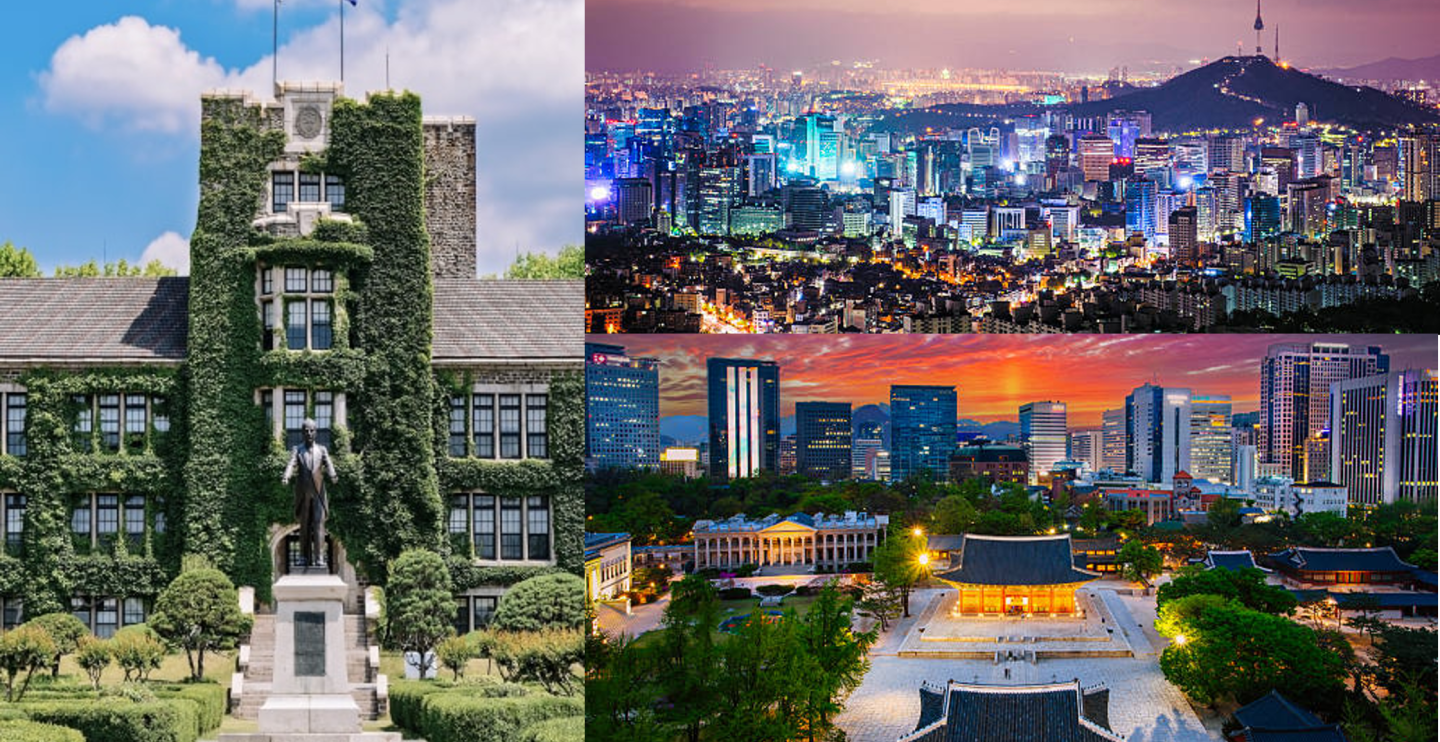
A four-week program in the Seoul, South Korea. This program engages students with interests in speech perception/recognition and processing, linguistics, or cognitive science.

Info session will be on September 16th. More details coming soon!

Contacts - 

  • Jeung-Yoon Choi (Global Classroom Program Leader) - jyechoi [at] mit.edu (jyechoi[at]mit[dot]edu) 
  • Matt Burt (MISTI Korea Managing Director) - mburt [at] mit.edu (mburt[at]mit[dot]edu) 

Program Information

Acoustic cues are characteristic patterns in the speech signal that can be interpreted to find the phonemes to the words of utterances. They are hypothesized to be common to all languages, and their interpretation process determines the mapping to different languages. However, speech databases annotated with acoustic cues are currently extremely scarce, especially in non-English/non-European languages. Thus, this Global Classroom project aims to address this need by recording and annotating speech data in Korean. Students will learn to identify acoustic cues in the speech signal, and will be involved in obtaining speech recordings from > 100 native Korean speakers. The resultant database will be used to explore the commonalities and/or differences in acoustic cues between Korean and English speech. 

This GC project will be offered in collaboration with the Department of Electrical and Electronic Engineering at Yonsei University in Seoul, South Korea during IAP 2027. Founded in 18 BC, Seoul is the capital and largest city of South Korea. It has been described as the world's "most wired city", recently recognized to be the first in technology readiness, and was named the World Design Capital in 2010. It is currently emerging as a hub for the music, entertainment, and cultural industries that have propelled K-pop and the Korean Wave to international prominence. Yonsei University, founded in 1885, is the top private research university in South Korea and in Asia overall, and is ranked 50th globally, according to the QS World University Rankings in 2026.

Program Dates: December 28, 2026 - January 29, 2027

Credit: This program is not for credit.

Requirements:

  • Preferred qualifications include backgrounds or interests in speech perception/recognition and processing, linguistics, and/or cognitive science. 
  • Proficiency in Korean is highly recommended.
  • No GPA minimum or pre-required courses.
  • This program is open to MIT undergraduate students only.

Application opens: September 2, 2026

Application deadline: September 24, 2026 at 11:59 PM

Apply here

Program Fee: $1500

Financial Aid:

The program fee for this Global Classroom is $1500 per undergraduate student. Applications will be reviewed without regard for financial aid need. This amount will be pro-rated based on the financial needs of each selected student. Thus, a student receiving 100% financial aid from MIT will be able to attend the Global Classroom free of cost, while someone receiving 50% financial aid will have a $750 fee. The Global Classroom will cover airfare, in-country travel, accommodation, meals, and program activities. 

Current plans are for shared rooms (2 to 4 persons/room) in a hostel near the program site, but may be switched to shared university dorm rooms, if available.

U.S. citizens do not need a visa to enter South Korea for short-term visits of up to 90 days for tourism or unpaid business. Students need a passport valid for at least 6 months, a return/onward ticket, and they must fill out an arrival card (electronically prior to your flight or on paper during the flight). The Korean Electronic Travel Authorization (K-ETA) is currently waived and optional for U.S. passport holders, but it is scheduled to become mandatory starting January 1, 2027.

The program will help all students who need a visa apply for one.

There will be a moderate amount of walking, including stairs. Some public transportation stops are not handicap accessible, so students should expect to climb stairs. 

Students with questions about accessibility are encouraged to contact Jeung-Yoon Choi (jyechoi [at] mit.edu (jyechoi[at]mit[dot]edu)) and MIT Disability and Access Services (das-student [at] mit.edu (das-student[at]mit[dot]edu)) early to discuss accommodations.