




- May 06, 2025
- Michelle English
"You’re always capable of more than you think, and you’ve never done something until you do it — so you should just take the first step, no matter how big it may seem."
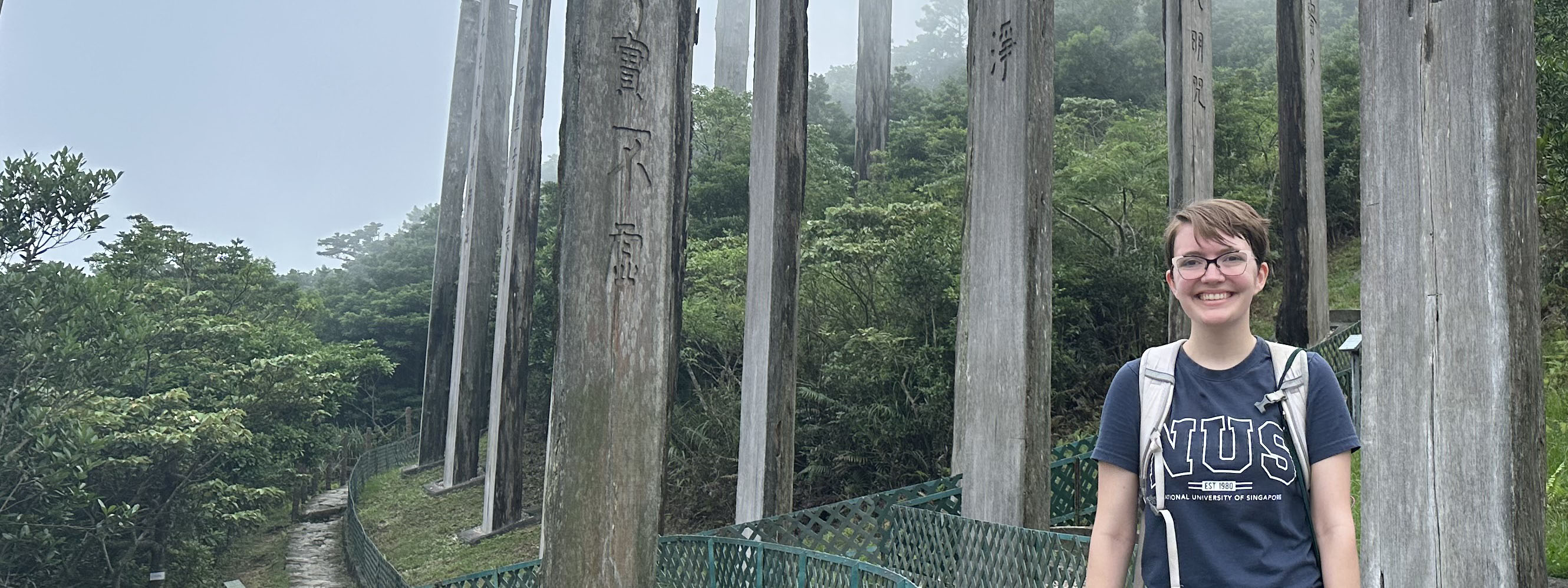
In just four years at MIT, Ellie Bultena has had an unparalleled experience spanning Singapore, mainland China, Hong Kong, and Taiwan. While earning degrees in electrical engineering and linguistics and studying Mandarin, Ellie has gone on summer internships at National University of Singapore and at Ardentec Semiconductor as part of a varied Taiwan industry experience. She participated in the Global Teaching Lab program in both Singapore and Beijing, and also in an Urbantech workshop in Hong Kong.
Ellie was a MISTI Fung Scholar Ambassador twice, participating in the Fung Foundation's Student Leadership Conferences in Shanghai and Hong Kong. She will be returning to Hong Kong this summer with a linguistics research internship at the Chinese University of Hong Kong before starting a linguistics PhD program there in the fall, where she will represent MIT and MISTI for years to come as a Future Global Leader in that dynamic region.
She received the 2026 Suzanne Berger Award for Future Global Leaders, presented annually to a graduating student who, through coursework and MISTI experiences abroad, has demonstrated the potential to become a global leader.
Ellie shared her thoughts on why she actively pursued MISTI experiences, her most memorable moments abroad, how MISTI has shaped her career path, and more.
1. Why did you choose to include MISTI in your 4-year journey at MIT?
MISTI was a key factor that attracted me to MIT, as I had always aimed to thoroughly integrate studying, working, and research experiences in Asia into my undergraduate career. I wholeheartedly believe in the importance of learning about experiences and people other than your own. I believe that understanding societies outside your bubble is how you can become a global citizen.
2. How did MISTI complement your studies at MIT?
After working on research-level device design at MIT through UROPs, it was fascinating to see the industry side of mass production of high-yield chips. Also, of course, all of my MISTI experiences were a fantastic complement to the intensive study of the Chinese language.
3. How can someone in your major benefit from doing MISTI?
For linguistics majors, it’s absolutely essential to be immersed in the environment of the languages you are researching. Outside of improving your own ability in the language, you encounter a massive amount of data each day that can inspire new research questions or demonstrate inconsistencies with previous research, rather than being confined to data from the literature or a limited sample of speakers.
For electrical engineering, since the US has outsourced manufacturing to Asia from the 1960s onward, American engineers know comparatively little about how our electronics are made. Generally, if you are working on chip design, you use software like Cadence to lay out the integrated circuit according to the manufacturer’s specified set of design rules. Then you send off the design, and the product is simply manufactured. Actually being on the ground is immensely helpful in understanding where design rule restrictions come from, where manufacturing technology is headed, what the workers’ experience is like, and the sheer number of discrete steps involved in chip manufacturing.
These are things you are not typically going to learn in the US, and I find it fascinating to understand the entire process of how electronics are made, from metal mining to manufacturing to design. In my opinion, it exposes you to some of the most interesting technical questions in the field. Digital IC design at this point is heavily automated, but in the actual manufacturing process, engineers in Taiwan are constantly trying to figure out how to improve device yield, even out temperature, ensure material uniformity, among other things.
4. If someone is hesitant about doing MISTI, what would you tell them?
You’re always capable of more than you think, and you’ve never done something until you do it — so you should just take the first step, no matter how big it may seem.
My freshman year, when I went to Singapore, many people in my hometown (a farming region in Kansas) were surprised. At that point, I wasn’t well-traveled in the U.S., and to immediately jump to living internationally, by myself, 9,000 miles away, was a shocking move to them. In reality, I had no trouble adjusting, and it was one of the most formative moments of my life.
5. What’s next for you, and how did MISTI influence your path?
I am going to pursue a PhD in linguistics at the Chinese University of Hong Kong. MISTI was absolutely integral to shaping this path — it was through MISTI that I gained experience doing linguistics in Asia, built a network in Hong Kong, met professors, and improved my Chinese such that I’m comfortable living there.