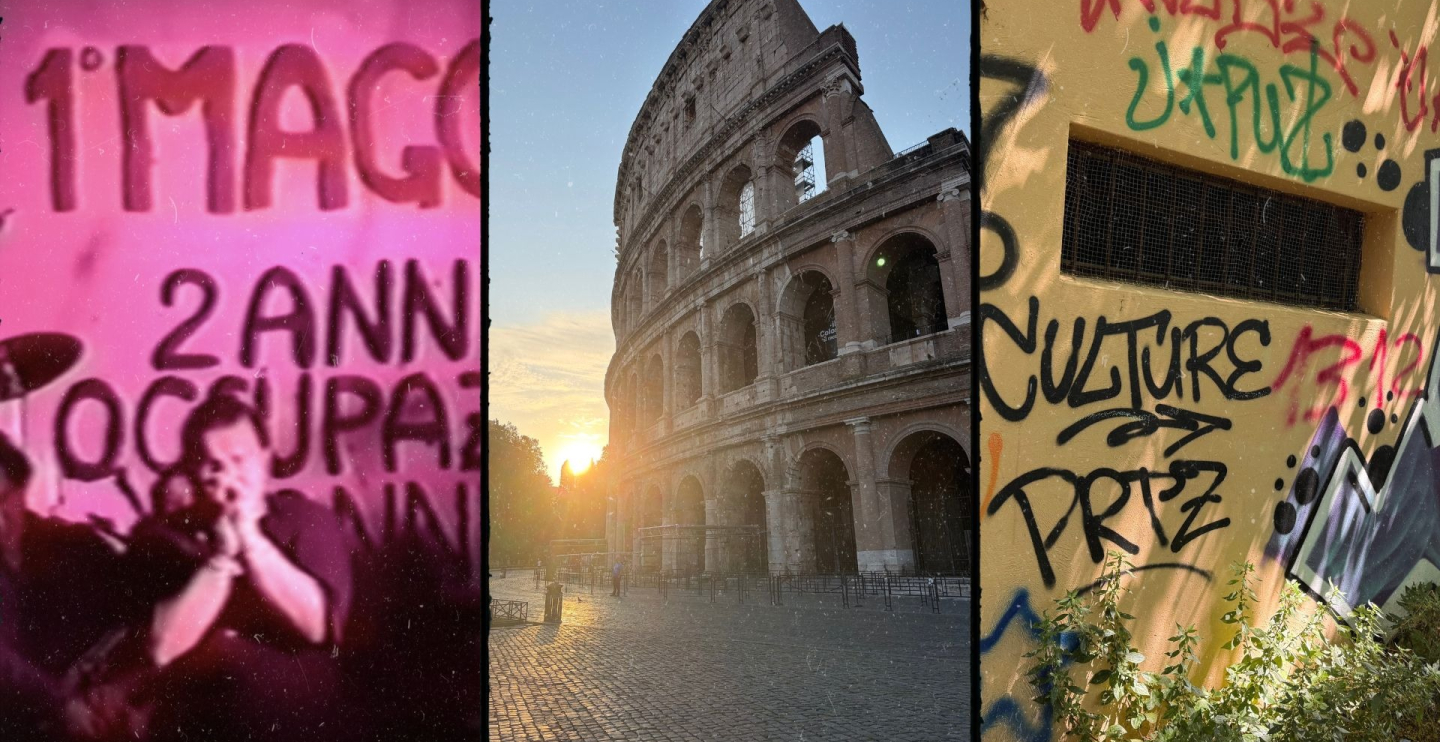
From the Forum to the Cypher will bring students to Rome and Bologna in IAP 2027 to explore the birth and growth of Hip Hop and rap through the history of Italy.

Info session details coming soon!

Contact - Amy Carleton, Ph.D. (amymarie [at] mit.edu)

Program Information

Italy has one of the oldest Hip Hop communities in Europe, dating to the mid-1980s, and today it is one of the continent’s most vibrant. In 2024, Italian artists held 100% of the top 10 album and singles chart positions, and domestic acts occupied 84% of the entire top 100—making Italy one of Europe’s most locally dominated music markets. 

Much of this dominance is driven by Hip Hop and rap. The genre’s Italian roots run deep: Bologna’s Isola Posse All Star emerged from the city’s left-wing social centers in the early 1990s and helped establish a distinctly Italian Hip Hop tradition that has since produced many artists with international reach, from Fabri Fibra and Marracash to Ghali and Sfera Ebbasta. And the connection between Italy and Hip Hop’s core elements runs deeper still: the walls of Pompeii preserve over 11,000 graffiti inscriptions—political endorsements, social commentary, personal declarations—that functioned as a form of public discourse strikingly parallel to the graffiti tradition that would become one of Hip Hop’s foundational pillars two millennia later.

From the Forum to the Cypher is a two-week immersive course that brings students to Rome and Bologna to examine the structural continuities between classical rhetorical traditions and contemporary Hip Hop culture. The course argues that Hip Hop’s cultural structure: its rhetorical practices, pedagogical systems, and civic knowledge traditions—replicate the classical humanistic framework that originated in Rome.

The course also examines the African diaspora in Italy, exploring how Black cultural production intersects with one of Europe’s oldest humanistic traditions. Through collaborations with Italian Hip Hop practitioners, scholars at the University of Bologna, and cultural organizations, students will investigate who gets to define knowledge, how cultural forms gain institutional recognition, and what democratic knowledge systems require.

Program Dates: January 7-22, 2027

Credit: This program is not for credit.

Requirements:

  • The course is taught entirely in English. No Italian needed.
  • There is no GPA Minimum, and there are no prerequisites.
  • This program is open to MIT undergraduate students only.

Application opens: September 2, 2026

Application deadline: September 30, 2026 at 11:59 PM


Apply here

Program Fee: $600

Financial Aid:

The program fee for this Global Classroom is $600 per undergraduate student. Applications will be reviewed without regard for financial aid need. This amount will be pro-rated based on the financial needs of each selected student. Thus, a student receiving 100% financial aid from MIT will be able to attend the Global Classroom free of cost, while someone receiving 50% financial aid will have a $300 fee. The Global Classroom will cover airfare, in-country travel, accommodation, meals, and program activities. 

Students are responsible for their own personal spending money for incidentals and non-group activities.

Students will stay in either stay in traditional hotel rooms (double occupancy) or centrally-located Airbnb accommodations--confirmed info will be provided at October pre-departure session.

United States citizens do not need a visa to travel to Italy.

Citizens of other countries should check the list of visa-required countries for the Schengen Area.

The program will help all students who need a visa apply for one.

Rome (and Bologna) are walking cities, which means we will routinely log 10K+ steps per day, thus comfortable walking shoes are essential. We also will make use of public transit (buses and metro) during our stay. The weather in January can be brisk, but is generally milder than Boston/Cambridge, so I recommend wearing layers (and packing a rain jacket just in case!) to stay comfortable.

Students with questions about accessibility are encouraged to contact Amy Carleton (amymarie [at] mit.edu) and MIT Disability and Access Services (das-student [at] mit.edu (das-student[at]mit[dot]edu)) early to discuss accommodations.