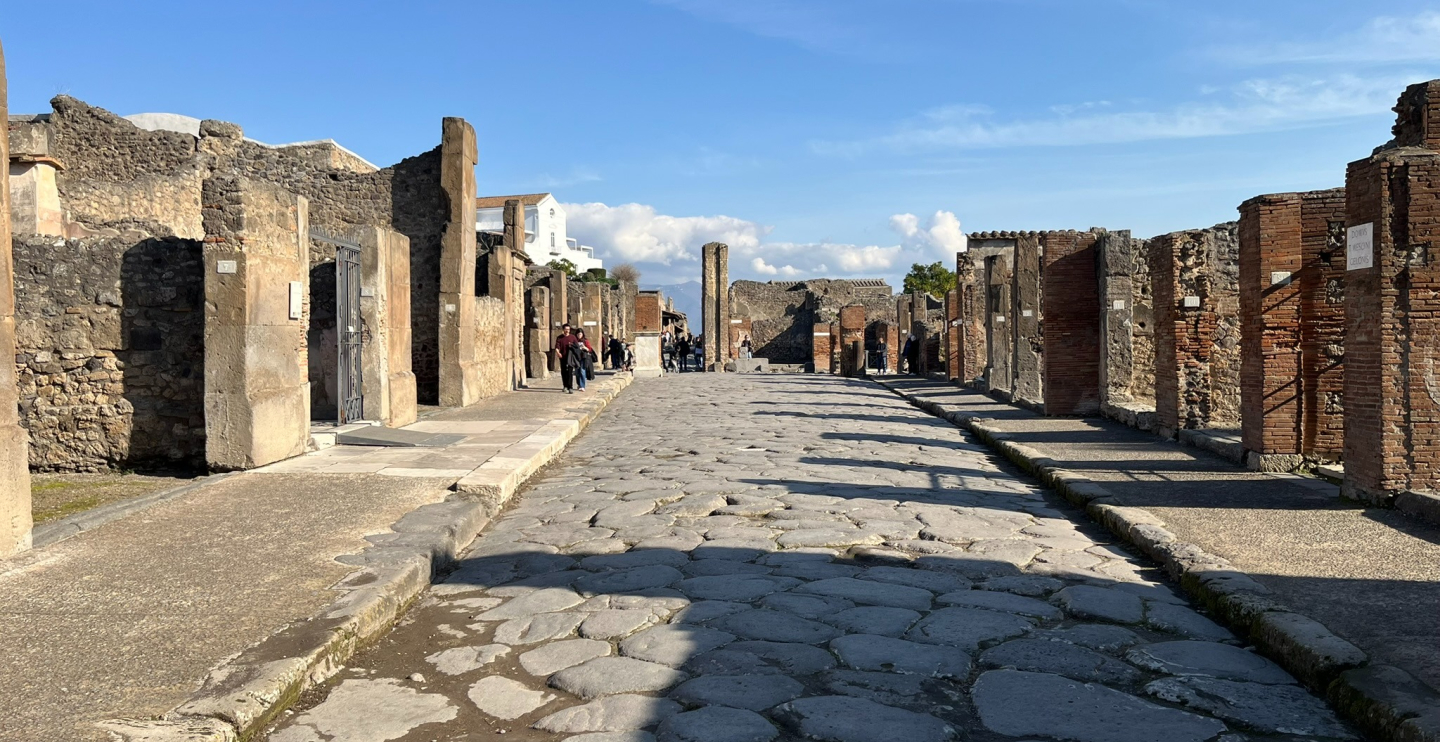
The Making of Roman Pompeii uses the archaeological site of Pompeii to understand the political, social, and cultural history of the ancient city.

Info session: Monday, September 21, 12-1pm, Room 1-236

Program Contacts:

  • Dr. Will Broadhead - williamb [at] mit.edu (williamb[at]mit[dot]edu)
  • Dr. Admir Masic - masic [at] mit.edu (masic[at]mit[dot]edu)
  • Dr. Mike Tarkanian - tarky [at] mit.edu (tarky[at]mit[dot]edu) 

Program Information

The Making of Roman Pompeii is a 9-unit IAP subject that uses the uniquely well-preserved archaeological site of Pompeii as a classroom and laboratory for an integrated humanistic and scientific exploration of the ancient city, allowing for a deep dive into the “making” of Roman Pompeii on several levels: political, architectural, artistic, economic, ethical, and material.

Focusing on the archaeological sites of Rome and especially Pompeii, the subject will combine on-site lectures and discussions exploring the political, social, and cultural history of the built environment with hands-on archaeological fieldwork analyses of ancient buildings and materials, providing students with an interdisciplinary window onto the life of the ancient city that will include political and institutional approaches to the urban community, art historical interpretation of Pompeiian art and architecture, the history of ideas reflected in the artistic and literary record of the city, materials science approaches to the physical fabric of the city, its concrete, plaster, and metallic remains, and experimental archaeology approaches to understanding the literal making of the ancient fabric of Pompeii.

The program will include three days in Rome and twelve days at Pompeii (including a one-day excursion to Herculaneum and to the National Archaeological Museum in Naples).

Program Dates: January 7-23, 2027

Credit: This course is 9 units. Course numbers include 1.059[J] / 3.079[J] / 21H.079[J],

Requirements:

  • First-year students are strongly encouraged to apply. Upper-class student applicants will benefit from demonstrated interest in one of the fields represented by the interdisciplinary content of the program. 
  • This program is open to MIT undergraduate students only.
  • There is no GPA Minimum.
  • There are no prerequisites, and there is no language requirement.

Application opens: September 8, 2026

Application deadline: October 8, 2026 at 11:59 PM


Apply here

Program Fee: $250

Additional Costs: 

Flights to Rome will be covered by the program up to $1000. Any costs above $1000 will be covered by the student.

Financial Aid:

The program fee for this Global Classroom is $250 per undergraduate student. Applications will be reviewed without regard for financial aid need. This amount will be pro-rated based on the financial needs of each selected student. Thus, a student receiving 100% financial aid from MIT will be able to attend the Global Classroom free of cost, while someone receiving 50% financial aid will have a $125 fee. The Global Classroom will cover airfare (up to $1000), in-country travel, accommodation, meals, and program activities. 

Students will stay in double or triple rooms in hotels in Rome and Pompeii.

United States citizens do not need a visa to travel to Italy.

Citizens of other countries should check the list of visa-required countries for the Schengen Area.

We will spend between 3 and 6 hours a day on archaeological sites in Rome and Pompeii engaged in lectures, discussions, and field work. There will be some stairs and many uneven surfaces, including ancient and modern cobblestone streets and sidewalks.

Students with questions about accessibility are encouraged to contact Will Broadhead (williamb [at] mit.edu (williamb[at]mit[dot]edu)) and MIT Disability and Access Services (das-student [at] mit.edu (das-student[at]mit[dot]edu)) early to discuss accommodations.