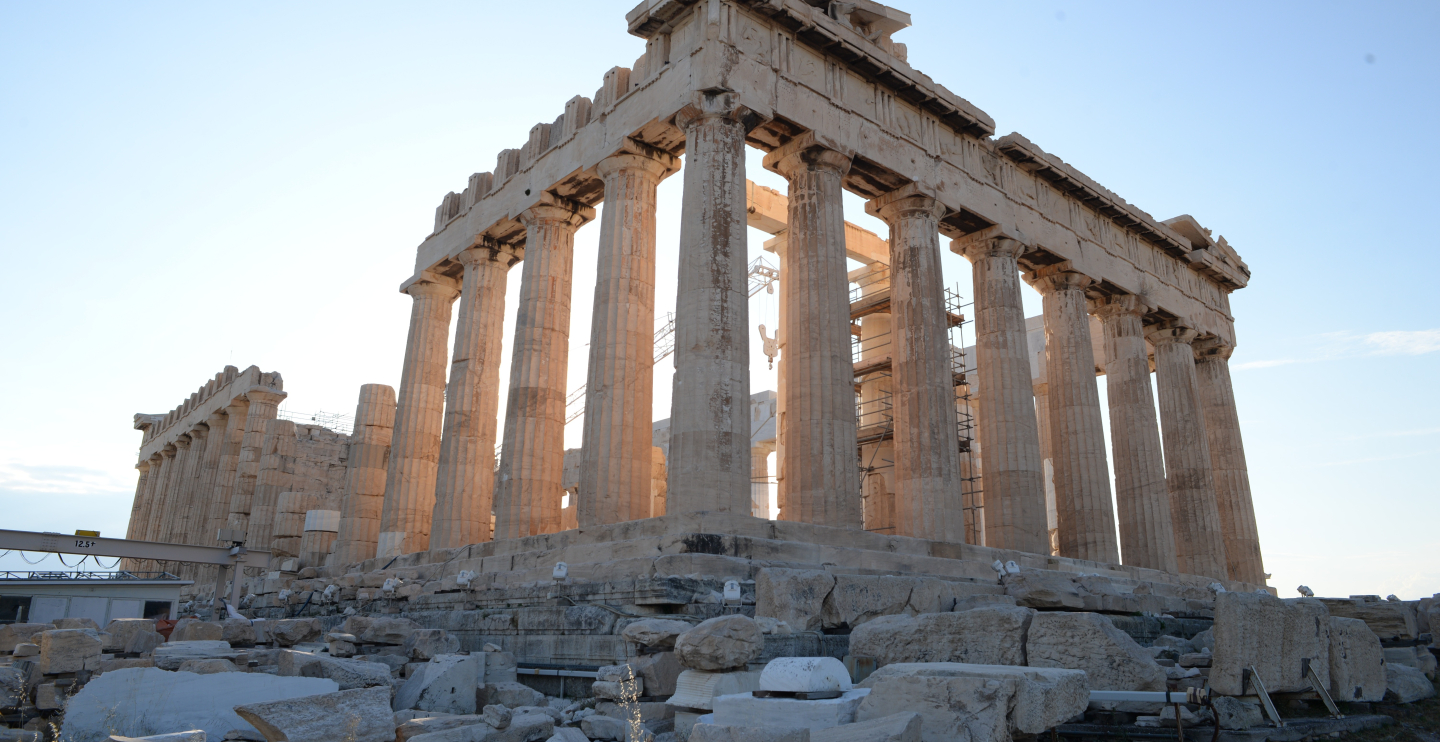
MIT undergrads will have the opportunity to travel to Greece in IAP 2027 to study and analyze history, art, and philosophy.

Info session details coming soon!

Contact - Dr. Eric Driscoll (edris [at] mit.edu

Program Information

Around the world, Ancient Greece continues to inspire curiosity and to impact art, political thought, literature, and more. In January 2027, MIT students will have the opportunity to explore this legacy at its source: across fifteen days in Greece, participants will learn from firsthand experience in sites and museums about the art and architecture, history and archaeology, culture and mythology of ancient Greece. From elaborate Bronze Age palaces to the temples of the Athenian Acropolis and the majestic sanctuary of Apollo at Delphi, and in museums of the environment, technology, and art, this program dives into the landscapes, cities, and crafted universe of the ancient Greeks. 

Medieval and modern Greece is just as significant as antiquity: a theater wherein empires dueled, religious and social identities were forged and reshaped, and one of modernity’s first new nation-states emerged. Accordingly, we will also visit sites and museums that shed light on the history, achievements, and struggles of more recent centuries. 

This kind of in-person study of the history, art, and philosophy of Greece is an extraordinary opportunity for you to have a direct and visceral encounter with a world different from their own. You will develop skills in formal analysis and learn how archaeologists reconstruct the past from its material remains; and you will also come to understand that historical meaning is debated in the present, not fixed in the past. 

The ruins of the past engage our imaginations and allow us to reflect on the transience of human life and accomplishments. Students will be led to reckon with the grandeur and importance of cities that no longer exist. Visiting these sites also generates a profound respect for history and the wealth of understanding that grappling with history makes possible: in Athens, for example, we will be visiting the proverbial birthplace of democracy and discussing its character in the very physical spaces wherein ancient Athenians debated the issues of their day. 

One of the most rewarding aspects of the program is the opportunity to converse, forge bonds, and get to know your instructors and fellow students outside a classroom setting. Beyond the familiar context of MIT, this kind of study generates discussion of the fleeting character of greatness and the passage of time, the importance of engaging our imagination, what is and isn’t accessible to us about the past, what counts as beauty and why is it important for human beings.

Find the full itinerary here.

Program Dates: January 5-21, 2027

Credit: This program is not for credit.

The program will range across southern and central Greece, including the island of Crete. In January, weather in Greece is usually brisk with the possibility of unusually cold and/or warm days, as well as rain (or even snow).

Requirements:

  • Demonstrated interest in ancient history and/or Greece and/or the Mediterranean region is a significant plus. 
  • This program is open to MIT undergraduate students only.

Application opens: September 16, 2026

Application deadline: October 8, 2026 at 11:59 PM


Apply here

Program Fee: $1500

Financial Aid:

The program fee for this Global Classroom is $1500 per undergraduate student. Applications will be reviewed without regard for financial aid need. This amount will be pro-rated based on the financial needs of each selected student. Thus, a student receiving 100% financial aid from MIT will be able to attend the Global Classroom free of cost, while someone receiving 50% financial aid will have a $750 fee. The Global Classroom will cover airfare, in-country travel, accommodation, meals, and program activities. 

Students will stay in shared hotel rooms, two to a room. 

Greece is part of the Schengen Area, which US passport holders may visit without a visa. Nationals of countries in Africa, Asia, and elsewhere may require a visa. 

By January 2027, however, the EU is expected to implement its new travel authorization system, which will require online registration (and payment of a small fee) before travel for visa-exempt visitors. 

The program will provide guidance about this process.

This program requires a significant amount of walking, sometimes over rough and/or steep terrain. Museums are generally accessible, whereas paths across archaeological sites are often uneven. Students should expect to be on their feet for 2-3 hours at a time. 

Students with questions about accessibility are encouraged to contact Eric Driscoll (edris [at] mit.edu) and MIT Disability and Access Services (das-student [at] mit.edu (das-student[at]mit[dot]edu)) early to discuss accommodations.