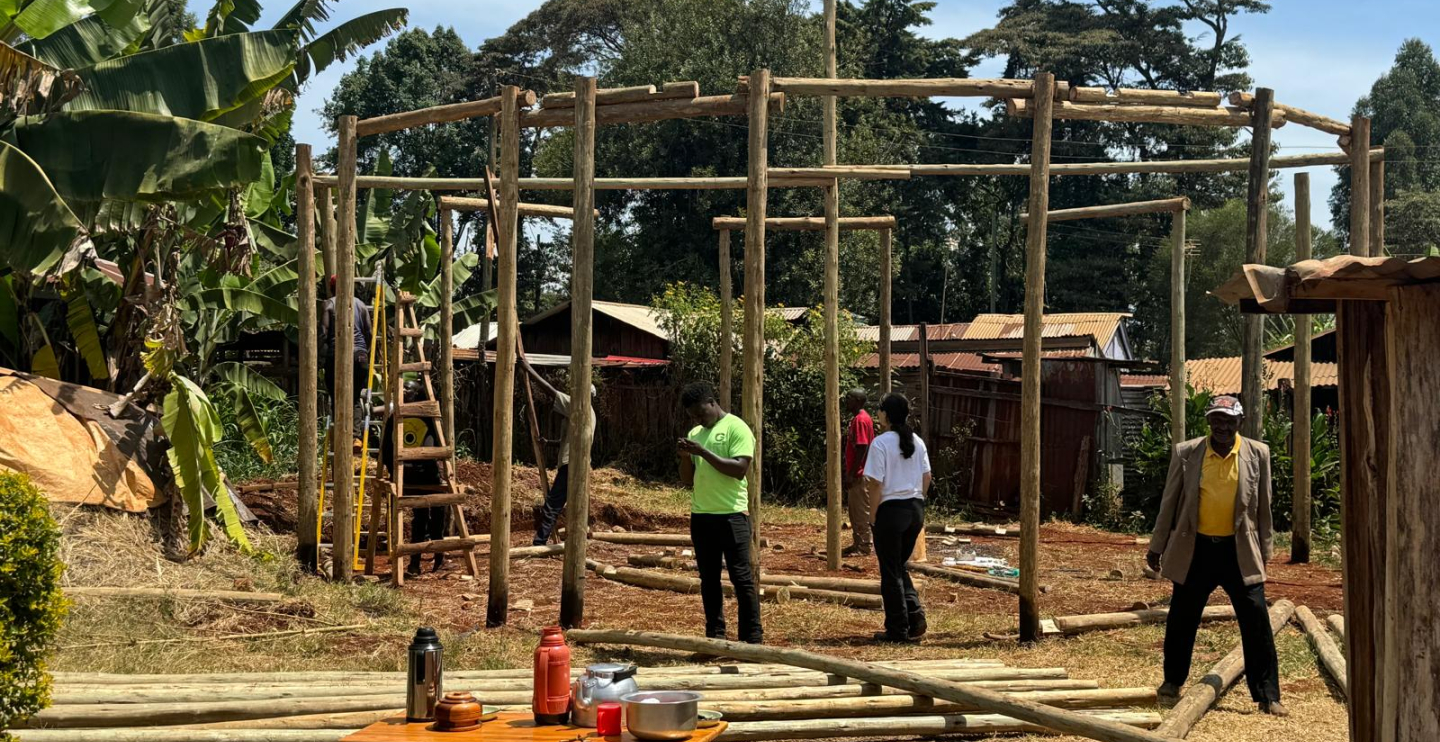
The Practical Field Lab in Kenya (STS.023) will bring students to Nyeri, Kenya, to address real-world problems faced by fish farmers.

Contact - Prof. Chakanetsa Mavhunga (mavhunga [at] mit.edu

To speak with Prof. Mavhunga about the program, check out the following events:

  • The Orientation Academic Expo, Tuesday, Sept. 1, 2026 Time: 3:00 PM - 4:30 PM in Johnson Ice Rink (1st years only).
  • STS Undergraduate Officer’s zoom office hours (Mon-Fri Sept 14-18, time 2.30-4pm) (all undergrads).

Program Information

The Practical Field Lab (PFL) is an off-campus, in-person experiential learning curriculum where faculty and students engage in learning through problem-solving at the intersection of multiple systems of knowledge and practice. It is already an approved course on STS’s IAP 2027 calendar. A partnership between the MIT Program in Science, Technology, and Society, MISTI Africa, and Origin Labs at Dedan Kimathi University of Technology (DEKUT), it constitutes the ultimate experience in community-based experiential learning for undergraduate students seeking to use their skills for social impact. Our STS curriculum is unorthodox and applied. Hence the “practical” is the actual work of turning problems into solutions. It is hands-on, applied work in authentic, real-world contexts. By “field” we mean a space where practical work can be turned into one of learning through doing, for example, a crop field, a river, a forest, a workshop, etc. “Lab” is the work done at that space, whose outcomes are tangible, are scientifically tested, and meet local social and technical standards. The PFL is grounded in humanities and social science approaches to the interactions between local and non-local (including in-bound) ideas and things that local people assign technological meaning and purpose to. This is the context and site within which we will learn through doing things that local people care about, that inform the objectives and methods, and the composition of instructors.

The objectives/goals of the PFL are to:

  1. Equip participants to translate academic knowledge into skills for turning problems into opportunities for interdisciplinary creativity and problem-solving; 
  2. Create dialogues and synergies between the rubrics, logics, and practices of science, technology, innovation and entrepreneurship in African everyday life, on one hand, and academia, and by extension, bringing the disciplines of humanities, arts, and social sciences, engineering, law, and life sciences to solve a problem on the ground, together.
  3. Build real solutions to actually existing problems affecting communities, countries, the planet, and space.
  4. Foster learning and education through making and building those solutions. The PFL is not a classroom; rather it unrooms the class and renders it a transient workspace and frees the professoriate to be among the people and build society with and through them (Mavhunga 2014). Emphasis is not on grades but the experience of team-based making and building.

The 2027 Class will travel to Nyeri, Kenya, to build on the principles of working at the intersection of multiple disciplines intentionally encompassing humanities, business, finance, science and technology studies, engineering, science, and everyday innovation. The sites—all located in communities off-campus—have been selected to provide opportunity for students to immerse themselves and add to people’s everyday innovation and creative resilience. The MIT students will be working with their peers at DEKUT, as well as TVET students, engineers and artisans, constituting a vibrant peer-to-peer and community-academy practical knowledge osmosis. While the focus is on addressing the toughest challenges affecting small-holder aquaculture, students will immediately find themselves innovating with farmers not only of fish but a unique circular aqua-agriculture systems, wherein wastes/by-products from one process are used as inputs in another. The sites have been pre-scoped to present students with an experience of circularity well beyond labels or corporate PR; rather, derived from smallholder farmers’ creative resilience and the necessity to survive. The student will be challenged to build upon this creative resilience and, with the people, to design, build, and apply advanced science and technology from a mindset of extreme thrift. 

All details are contained in the "Task Sheet" (Syllabus); additional information will be provided as needed.

Program Dates: January 4-29, 2027

Credit: This course is 12 units. The course number is STS.023.

Requirements:

  • Students who have taken the STS. 088 Introduction to Science, Technology, and Innovation in Africa class will have an added advantage
  • No language requirements necessary
  • Students must be maintaining a 3.8 GPA and certainly no incompletes
  • This program is open to MIT undergraduate students only.

Application opens: September 2, 2026

Application deadline: October 14, 2026 at 11:59 PM


Apply here

Program Fee: $1500

Financial Aid:

The program fee for this Global Classroom is $1500 per undergraduate student. Applications will be reviewed without regard for financial aid need. This amount will be pro-rated based on the financial needs of each selected student. Thus, a student receiving 100% financial aid from MIT will be able to attend the Global Classroom free of cost, while someone receiving 50% financial aid will have a $750 fee. The Global Classroom will cover airfare, in-country travel, accommodation, meals, and program activities. 

There will be varied options depending on the work site location, availability of good quality accommodation with good security, and within easy reach of work site. The three categories of accommodation are homestay, lodge, and one-bed apartment. This is shared accommodation; students who wish to have their own room will pay an additional fee. 

Yes, Kenya uses an easy Electronic Visa system call the ELECTRONIC TRAVEL AUTHORIZATION.
 
The official Kenya e-visa (Electronic Travel Authorization) website is https://www.etakenya.go.ke.

The Government of Kenya requires all travelers to obtain an Electronic Travel Authorization (eTA) before entering the country, effective from January 5, 2024. This new portal, https://www.etakenya.go.ke, replaces the previous e-visa platform (www.evisa.go.ke) and is the only official site for submitting applications, making payments, and checking application status.

KEY POINTS REGARDING THE E-VISA SYSTEM
Mandatory for all travelers (including infants and children) unless specifically exempted.

Application process: Submit personal details, travel information, and required documents online.

Processing: Travelers are advised to apply at least two weeks before departure to ensure timely approval 

Support: For inquiries, applicants can contact etakenya [at] immigration.go.ke 

Using any other website may result in fraudulent charges or invalid visas, so always ensure you are on the official government portal.

Both MIT Africa office and the DeKUT international office, working together, will guide admitted students in the application process.

The Practical Field Lab will be conducted in the Mt. Kenya region. It will involve walking, a lot of stairs, and a work day of 6 hours (Monday through Friday). We will be building stuff with our minds and hands. 

Students with questions about accessibility are encouraged to contact Professor Chakanetsa Mavhunga (mavhunga [at] mit.edu) and MIT Disability and Access Services (das-student [at] mit.edu (das-student[at]mit[dot]edu)) early to discuss accommodations.